Who is ELABIT?
I am Simon Meggle and the managing director of ELABIT GmbH. This is my story.
Basic research
And this story begins with me, at around 11 years old, commandeering my father’s Schneider Euro PC and, together with my best friend at the time, typing out pages upon pages of BASIC listings from magazines, which were eventually supposed to result in a game. But they didn’t. Never.
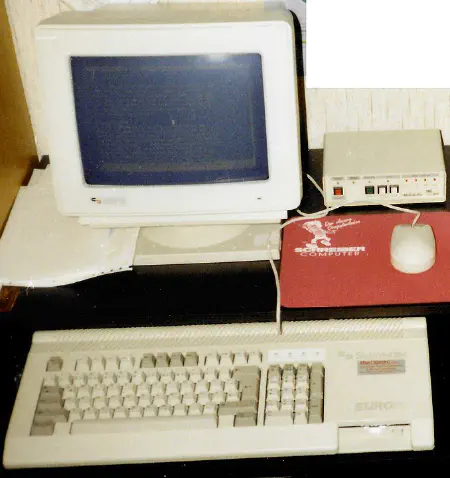
We had become so ‘professional’ that my mate would dictate and I would type away like a man possessed. But not a single game would work; instead, after hours of ‘work’, we were just bombarded with more and more error messages. (Looking back now, I put this down to the fact that we didn’t have the faintest idea what we were actually typing into the computer…)
Self-taught learning without the internet
My “real” interest in computers was sparked in 1993 in the school’s computer room – at a time when people still used Altavista to search the web, Netscape Navigator was all the rage and Pegasus Mail had only just seen the light of day. During this time, I became the layout designer for the school newspaper.
What an opportunity: at last I’d found a valid reason to buy my own PC. With my heart pounding and 1,000 DM lighter, I walked out of the shop with a Pentium I and a colour(!) monitor (back then, there was still ESCOM). One of my first challenges was cracking the copy protection on the DTP programme ‘Quark Express’… After a frantic installation session involving a dozen floppy disks, I sat in front of this programme night after night with no prior knowledge and no manual, teaching myself the ropes to get the school newspaper into shape. From today’s perspective, it’s unimaginable how I managed to get to grips with it without the internet…
Nagios enters my life
In the autumn of 2000, I began an apprenticeship as an ‘IT Specialist in System Integration’ at the large Munich-based patent law firm TBK. Lots of tinkering with PCs, printers and photocopiers, and my first small programming tasks in DOS and Object Pascal (Delphi).
I installed my first Nagios server (and my first Linux system) in early 2002. I was hooked: finally, no more “flying by the seat of my pants”, no more “user-based monitoring”. At last, I could collect the vital statistics of “my” infrastructure on a single system and have myself and my colleagues notified of any issues.
A stiff breeze
2009 I moved to WIRECARD AG, where I was primarily responsible for Nagios monitoring operations. It was a real challenge there, but I grew with the task.
I taught myself Perl so that I could implement the monitoring requirements coming in from all directions, and used it to program a small tool for evaluating Nagios availability figures in Excel. Along the way, I learnt to use Puppet to automatically generate configuration files for Nagios.
The Nagios community: good ol’ times
Incidentally, at that time there was still something of a united “Nagios community”, which engaged in lively discussion on nagios-portal.de (you’re better off not visiting that link at all, it’s dead – thanks Ethan Galstad) and organised the well-attended annual “Nagios Workshop”.
It was there that I gave my first talk on RRDTool in 2010 (RRDTool background information) and got a taste of being a speaker. There was also a monthly “Nagios get-together” in Munich – where, among other things, I met the lads who would later become my colleagues…
Cluster construction
At the end of 2010, I longed once again for a more generalist role and joined Mobility Concept (car fleet management, UniCredit). And once again: a greenfield site, a new monitoring system was needed! Here I was able to try out and implement Checkmk for the first time. Fortunately, I didn’t question why, apart from “must be open source”, the only requirement for the new monitoring system was, of all things, “high availability”. The infrastructure was, after all, really quite manageable.
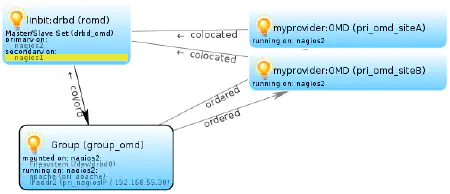
Anyway, I got to grips with DRBD and Pacemaker, dissected the OMD code (back then still the “one and only” OMD) and worked out how to run CheckMK/OMD in an active/passive cluster. It worked, and surprisingly well at that. I was given permission to publish the project documentation, and soon had a comprehensive six-part tutorial in blog form ready.
‘Sagamoi, do you have too much time on your hands?’
2011: the blog had just gone live, I walked into the Franziskaner beer garden in Munich for the monthly ‘Monitoring Stammtisch’ and Gerhard Laußer, team lead at Consol (Munich), approached me with a wink: ‘Sagamoi, do you have time?’ … And three or four wheat beers later, I know that I’ll soon be “switching sides” and will be joining his monitoring team at Consol as a consultant. My time at Consol 2011–2018 was incredibly exciting, creative and flew by. I managed large and small OMD monitoring environments, programmed countless monitoring plugins, learnt Ansible and Python, and also supported the development of OMD (or rather the Consol fork OMD-Labs).
Sakuli: End2End, to End'
2014 I really struggled with a client project: I wanted to monitor a smartcard-protected intranet site using the web testing tool Sahi and Nagios. However, the PIN prompt was not a web element, so together with a colleague I laid the foundations for the open-source project Sakuli, which could handle both web content (with Sahi) and GUI elements (with SikuliX). Certainly one of the largest, most technically challenging and most interesting projects we tackled with Sakuli was the implementation of a globally distributed application performance monitoring system at LIDL Stiftung & Co.KG.
Self-employment: ELABIT
In early 2018, I felt that something had to change. The answer to that question was what my wife had been telling me for years, but which I had never taken seriously: taking the leap into self-employment. And now, suddenly, there was this thought that wouldn’t let me go.
Time for a retreat. I packed my suitcase, my Mac and a stack of books and booked a room via Airbnb in a student flat-share near Erlangen, just beyond the edge of Nowhere. Those three days were good for reading a lot and sorting through all my scattered thoughts and making plans.
My start-up advisor, whose services I was able to fund through pre-start-up coaching, also helped me with this later on. Because if you want the coveted start-up grant (9 months of ALG1), you have to present your project to the Job Centre with a business and financial plan. And somehow, right up until the launch date in autumn 2018, one piece of the puzzle fell into place after another. Website, insurance, Business Model Canvas, positioning, etc. The icing on the cake came two weeks before I registered my business: the news that I was getting my own office in my home town of Merching, specifically at “Gewerbering 3”. Well, doesn’t that sound better than “Kirchberg 2” 🙂
2019: Robot Framework and RobotMK
Sakuli v1 was replaced shortly after I left Consol by a paid rewrite Sakuli.io (which, however, has since also been discontinued). There I was, with my newly founded company ‘ELABIT’. I’d firmly counted on being able to use Sakuli v1 in my own business too – and now this… My options weren’t exactly promising:
-
Carry on developing Sakuli v1 on my own? Impossible, especially as Sakuli v1 was based on a somewhat “quirky” architecture using the “Sahi” tool.
-
Use Sakuli v2? Out of the question for me, as it is a) commercial and b) the user base is, in my view, far too small (no offence!). And so I had to look for a replacement for Sakuli to fill the gap in my portfolio. Questions that were on my mind: which testing tool…
-
won’t turn me, as a solopreneur, into a techie stuck with a proprietary solution?
-
can be used across disciplines?
-
has open interfaces?
-
has been on the market long enough to stay there for at least as long?
-
has a large community?
-
does it convince me 100%, so that I can and want to support myself and my family with it? I was amazed at how thoroughly and intensively one can suddenly research when you have all these questions in your head at once! :-)
What I wanted:
- I wanted a tool that can test everything.
- I wanted a tool that runs on any OS.
- I wanted a tool that is extensible.
- I wanted a tool with a standardised output format.
…and came across Robot Framework.
And so, at the end of 2019, I wrote the first prototype of RobotMK.
On the spur of the moment, I also booked a flight to attend Robocon 2020 in Helsinki in February 2020, to meet the people behind Robot Framework in person.
They were still looking for Lightning Talks, and there was a large poster hanging on the foyer window with the words ‘Sign up for a lightning talk!’
On the spur of the moment, I scribbled my name on it, for which I could have slapped myself that very evening: how could I be so daft as to sign up for a lightning talk on the spur of the moment without having anything even remotely workable, let alone knowing whether “monitoring” was even a thing in the context of Robot Framework?
It was no use; I sat on the sofa of the Airbnb flat late into the night, cobbling together a presentation with a live demo.
(At that time, Robotmk could do little more than collect results and discover one service per test case)
When I stood on stage on the second day, I was absolutely terrified. My opening question, asking who was familiar with Checkmk or Nagios, was actually intended as an ‘icebreaker’ – the few hands that went up didn’t exactly give me much courage…
But it went surprisingly well; people were interested, asked questions and came up to me after the session. And I realised two things during these conversations:
- People weren’t just interested in Robotmk, but in Checkmk in general. So why not bring these two worlds together?
- The Robot Framework community is very active and helpful.
2020: Support
As a freelancer, I need to earn a living somehow, so I was very grateful for two supporters without whom Robotmk wouldn’t have come about so quickly – or at all: Hardy Düttmann (Iteratio) can rightly be described as the “midwife” of Robotmk – he quickly recognised Robotmk’s potential and sponsored a few days of development time to stabilise the project. Soon the first MKP was uploaded to Checkmk Exchange and people began trying out Robotmk in their Checkmk environments.
And Jens Dunkelberg (Abraxas, CH) ensured that I could get started with Robotmk in a POC from mid-2020 – the aim was to evaluate which end-to-end (E2E) solution Abraxas AG should choose to monitor the availability and performance of the Swiss federal authorities’ applications.
Robotmk already stood out from its commercial competitors back then – which was less down to Robotmk itself and more to the fact that Abraxas recognised the advantages of an open-source solution and didn’t just look at the features.
Jens championed the idea of using Robotmk to monitor the entire application landscape. During this time, I acquired much of the knowledge that I benefit from today and pass on in my training courses.
And he always ensured there was a well-stocked backlog: many of the features and ideas that are now part of Robotmk originate from this period.
2022: Checkmk
It didn’t take long for Checkmk to take notice of Robotmk: in spring 2022, I had the opportunity to present Robotmk internally at Checkmk, and soon after we established a collaboration from which we both continue to benefit greatly to this day: I joined Checkmk as a part-time product manager for Robotmk.
With the Checkmk 2.3 release, Robotmk was then launched in Checkmk for the first time as “Synthetic Monitoring”.
It gives me great satisfaction that Robotmk helps companies from all over the world and across a wide range of industries to test their business applications: Banks, insurance companies, public authorities, aviation/transport, industry, publishing houses etc…
And the combination of my freelance work (consulting, training, support) and the collaboration with Checkmk (product management, development) is full of synergy.
And what does ELABIT mean?
ELABIT is a coined word made up of
elaborate(to work out)bitlab(to tinker, to potter about…).
The name ELABIT conveys what I live by and what I offer my clients.